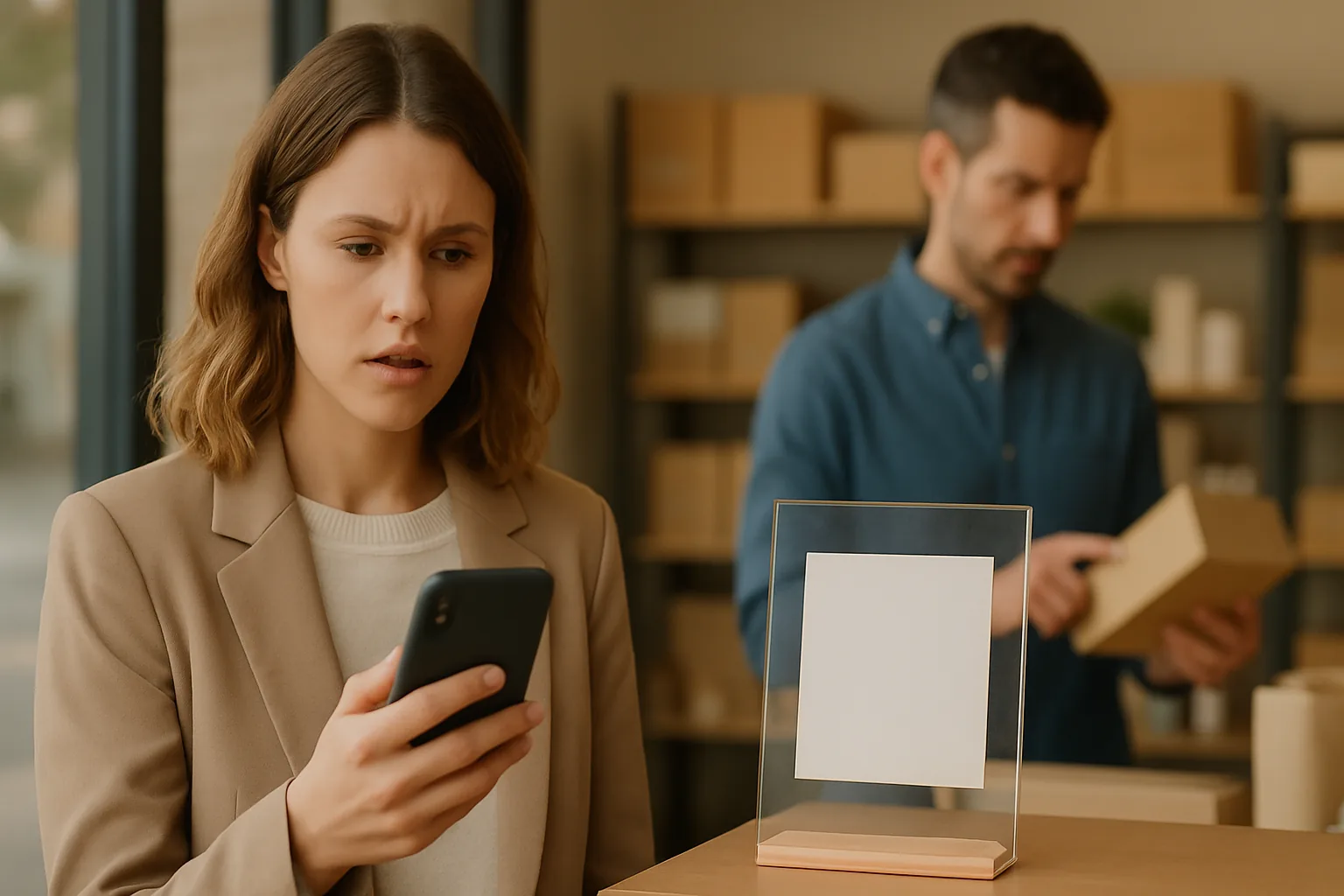
Physical QR codes can be overwritten with a sticker in under five seconds. That one fact should change how you think about every code you print and every code you scan. Unlike digital phishing links, tampered QR codes are invisible to email filters and browser warnings — the only defence is knowing what to look for.
What QR Code Tampering Actually Looks Like
Tampering doesn't require a sophisticated attacker. The most common method is a printed sticker placed directly over a legitimate code on a flyer, table tent, parking meter, or restaurant menu. The sticker looks identical in size and colour to the original, but the encoded URL leads to a credential-harvesting page or a payment portal the attacker controls.
Three real-world contexts where this happens most often:
- Payment QR codes at food stalls, market vendors, or parking machines — the attacker's code redirects to a fake payment page that captures card details.
- Public venue codes on posters or door signs that promise Wi-Fi access, a menu, or event information.
- Delivery and logistics labels where tampered codes redirect tracking links so customers or staff are misdirected.
The attack works because most people act fast. They point a camera, see a familiar-looking URL preview, and tap through before reading it carefully.
Why Standard Security Tools Miss It
Corporate firewalls and antivirus software protect devices at the network layer, not at the moment a camera decodes a module pattern on paper. A QR code isn't a clickable URL inside an email; it's an optical payload. That gap is exactly what attackers exploit.
Dynamic QR codes — which encode a short redirect URL rather than the final destination — make this worse if they're not managed carefully. The redirect endpoint can be changed at any time, meaning a legitimate dynamic code could theoretically be hijacked if the generating account is compromised. Understanding how dynamic codes work versus static ones is the first step to knowing which risk applies to you.
How to Detect Tampering Before You Scan
Inspect the physical substrate first. Run a fingertip across the code. A sticker has edges. You should feel them even when the printing is good. Look for lifted corners, misaligned borders, or a slight colour mismatch between the code and the surrounding material.
Check the URL preview before tapping. Every modern smartphone camera app shows the decoded URL before you confirm. Read it. Ask three questions:
- Is the domain exactly what I expected (not
paypa1.comormenu-venue-uk.xyz)? - Does it use HTTPS?
- Is there anything unexpected appended — a long query string, an odd subdomain, characters that look like letters but aren't?
Match the context. A QR code on a parking machine that asks for your full card number and CVV on a third-party site is wrong. Legitimate parking apps capture payment inside a verified app, not a mobile web form you've never seen.
Controls You Should Put in Place as a Code Owner
If you publish QR codes for customers to scan, you carry some responsibility for their safety. Here's a practical control list:
Physical deployment controls
- Laminate or varnish over codes on long-lived print. A sticker can't adhere cleanly to a gloss laminate without visible bubbling.
- Print codes directly onto primary signage, not as a separate label that can be swapped. Embossing or engraving is even stronger for permanent fixtures.
- Add a human-readable URL beneath every code. Tampering that replaces the code can't also replace the printed text without obvious evidence.
Campaign management controls
- Use dynamic codes only from a platform that logs every redirect change with a timestamp and user account. That audit trail matters in an incident investigation.
- Rotate or expire codes that were displayed in high-risk public locations after the campaign ends. Dead codes can't be redirected, but they also can't be abused.
- Monitor scan analytics for anomalies: a sudden spike in scans from a geography your campaign doesn't target, or a sharp drop in conversion rate despite high scan volume, can both signal that a tampered code is now in circulation.
Verification signals you can add to the code itself
- Branded visual design — a custom colour scheme, logo, or eye shape that matches your other marketing — makes a plain-black replacement sticker visually inconsistent. Our guide to designing branded QR codes covers the implementation details without sacrificing scannability.
- Domain consistency — always use the same short domain across all your codes so customers learn what to expect in the preview.
What to Do When You Discover a Tampered Code
- Photograph the tampered code in situ before removing it — document the sticker placement, surrounding signage, and location.
- Remove or cover the tampered code immediately to stop further victims.
- Redirect the original dynamic code's destination URL to a page that says the code was compromised and provides a safe alternative link. Don't just delete the short URL — that could allow it to be re-registered.
- Report to local police and, if payment fraud is involved, to your acquiring bank or payment processor. Many jurisdictions treat this as fraud rather than criminal damage, which affects the reporting route.
- Notify customers if you have any evidence that scans occurred between the tampering and your discovery. Brief, factual communication is better than silence.
Key Takeaways
- Physical tampering is fast, cheap, and bypasses most digital security controls.
- The best defences are tactile (laminate, emboss) and visual (branded design, printed URL).
- Dynamic codes need account-level security and audit logs — weak credentials turn them into an attack vector.
- Scan analytics can serve as an early-warning system if you know what anomalies to look for.
- As a code publisher, your responsibility doesn't end at print — it extends through the full lifecycle of the code in the world.
Whether you're deploying a handful of table codes or running a city-wide campaign, Super QR Code Generator gives you the dynamic code management, branded design tools, and scan analytics needed to keep every code accountable.